
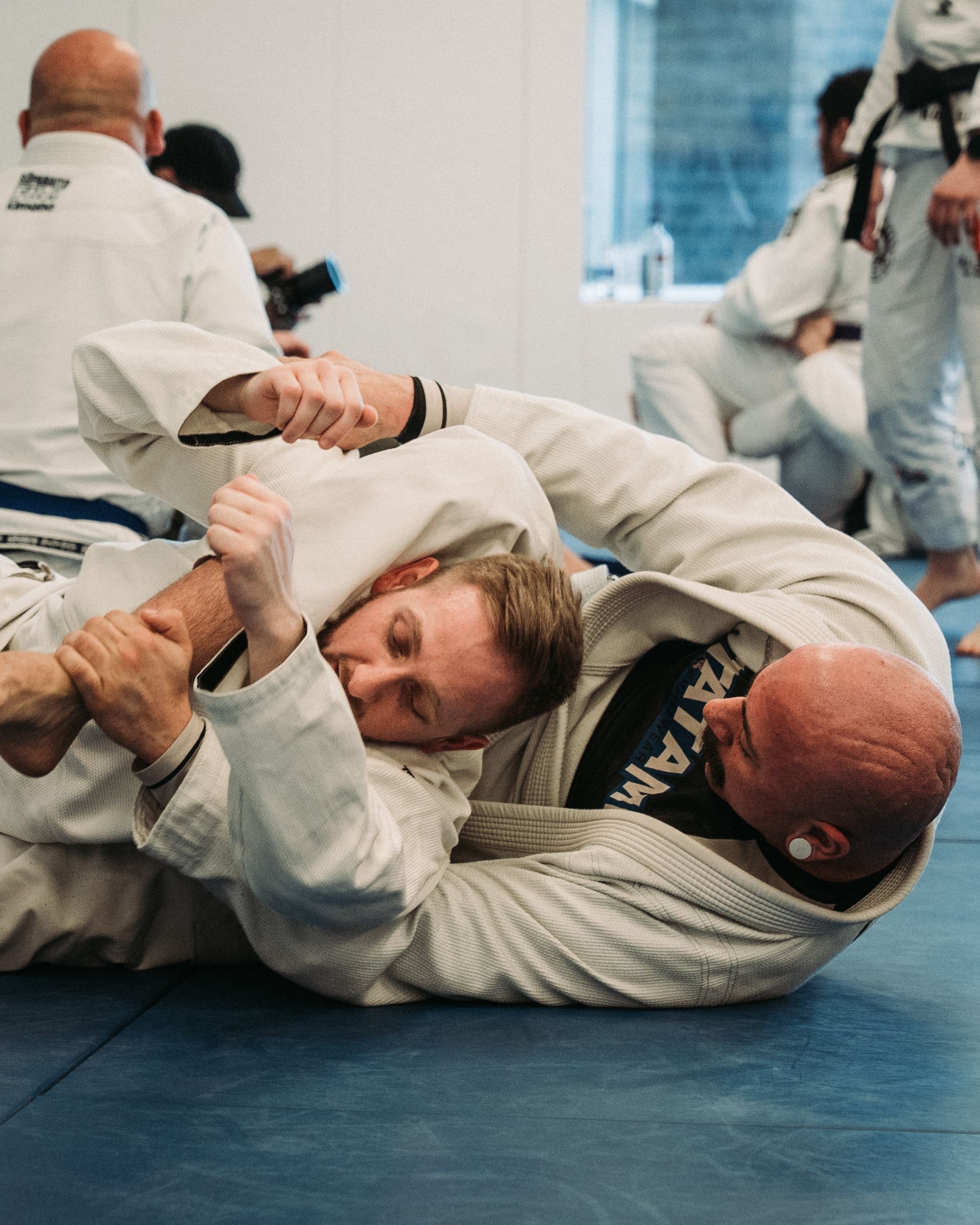
The fastest growth in Jiu-jitsu isn’t just about technique, it’s about finding a place where you belong and keep getting back up.
Jiu-jitsu keeps growing for a reason: it gives you something real to practice, with real people, on real days when motivation is high and on days when it definitely isn’t. Worldwide, there are roughly 6 million practitioners, and the United States alone has hundreds of thousands of active students as of late 2024 and early 2025. That kind of momentum only happens when training improves lives in practical ways.
In Montgomery, NJ, that matters. We’re a family-oriented community near Princeton, and people here tend to look for activities that do more than “burn calories.” Our mats are where neighbors become training partners, where adults find a steady stress outlet, and where resilience becomes something you can feel in your posture, your breathing, and your decisions.
This article breaks down how Jiu-jitsu builds community and resilience locally, what training actually looks like week to week, and how to start in a way that’s sustainable. If you’ve been curious about Jiu-jitsu in Montgomery, NJ, this is the grounded, day-to-day view we wish everyone had before their first class.
Why Jiu-jitsu creates community faster than most fitness routines
Most workouts are parallel play. You show up, put in effort near other people, and go home. Jiu-jitsu is different because it’s cooperative by design. You need partners, and you need trust. Even when training is intense, the goal is to help each other improve and walk out healthy enough to come back tomorrow.
That shared responsibility changes the social dynamic quickly. You learn names faster because you’re literally solving problems together. You start to notice who gives helpful feedback, who keeps a steady pace, and who can lighten a hard round with a simple “good work.” Over time, those small interactions become a genuine network.
We also see how structure supports community. Classes have a rhythm: warm-up, technique, drilling, and live training at appropriate intensity. That predictable flow helps new students relax. When you know what’s coming, you’re less likely to freeze up, and it’s easier to connect with the people around you.
Resilience on the mat becomes resilience off the mat
Resilience is a popular word, but on the mats it’s measurable. It shows up when you’re stuck under pressure, you feel your breathing tighten, and you learn to solve the moment anyway. Jiu-jitsu teaches you how to stay present under stress, pick a next step, and commit to it.
One reason it works is that the feedback is immediate. When something fails, you don’t need a lecture to understand it. You simply reset, adjust, and try again. That cycle, repeated over months, builds a calm kind of confidence that people often describe as “I don’t panic as easily anymore,” which is a pretty useful life skill.
It also reframes setbacks. A tough round doesn’t mean you’re not improving; it often means you’re training with people who are helping you grow. That’s a subtle mental shift, but it matters. Over time, you start seeing hard moments as information instead of proof that you “can’t do it.”
The beginner gap: why support matters in the first few months
Brazilian Jiu-jitsu is famously challenging at the beginning, and the stats reflect it. Industry estimates suggest about 70 percent of white belts quit early, while only about 1 percent eventually reach black belt. We don’t share that to be dramatic; we share it because it highlights what beginners actually need: a supportive onboarding process and a pace that keeps training enjoyable.
Early frustration is normal. The movements are unfamiliar. You may feel clumsy. You may leave class thinking, “I understood it while we drilled, and then it disappeared when we rolled.” That’s not failure; that’s how learning works under live resistance.
Our job as coaches is to keep the learning curve from turning into a wall. We do that by emphasizing fundamentals, helping you choose safe training partners, and reinforcing that consistency beats intensity. When you stick with it, the improvement sneaks up on you, and it’s honestly one of the best parts of the journey.
What community looks like here in Montgomery, NJ
Community isn’t a slogan. It’s built through ordinary moments: helping a new student tie a belt, sharing a quick tip after class, or seeing familiar faces on the same nights each week. In a suburban town like Montgomery, those small routines can become an anchor, especially for adults juggling work, parenting, and everything else that fills a calendar.
We also see community grow through shared milestones. Your first month of consistent classes is a milestone. Your first time escaping a position that used to trap you is a milestone. Even showing up on a rainy night when you’d rather stay home, that counts too. Jiu-jitsu gives you many “small wins,” and those wins feel better when the people around you notice and celebrate them with you.
And yes, it becomes intergenerational. Many academies report high family participation rates, sometimes as high as 87 percent in family-involved environments. When parents and kids train in the same place, you get a positive ripple effect: shared language, shared goals, and a healthier way to talk about effort and patience.
Adult training: functional strength, stress relief, and a real skill
If you’re exploring adult Jiu-jitsu in Montgomery, NJ, you’re probably balancing goals. You want to get in shape, but you also want something more engaging than another routine you’ll abandon by February. You may want self-defense skill, but you may also want a hobby that feels like a community, not a chore.
Jiu-jitsu checks those boxes because it’s both physical and strategic. You build functional strength through pulling, framing, bridging, and maintaining posture under pressure. You improve mobility because your body learns to move in controlled, efficient ways. And mentally, you get a break from the endless scroll because class demands full attention.
A useful reference point: many practitioners average around six hours of training per week. You don’t have to start there. A sustainable beginning for many adults is two to three classes weekly, then building up as your recovery and schedule allow.
Safety, injuries, and the kind of resilience that’s practical
Let’s be honest: Jiu-jitsu is a contact sport, and injury risk is real. Some surveys suggest a notable portion of students report injuries over a six-month window, especially with higher training frequency. But the conversation doesn’t end at risk. What matters is how you train.
We treat safety as a skill you learn, not a rule you memorize. You’ll learn how to tap early, how to protect your joints, and how to choose intensity based on the day. You’ll also learn that smart training partners are gold. The best rounds often aren’t the hardest; they’re the most controlled and technical.
Resilience, in this context, includes learning how to manage your body long-term. That means taking rest seriously, communicating when something feels off, and building a routine you can maintain for years, not just weeks.
What you’ll practice in a fundamentals-first approach
Jiu-jitsu can look like chaos to a first-time observer, but the fundamentals are surprisingly clear once you start organizing them. We focus on positions and concepts that repeat everywhere, so you’re not memorizing random moves.
Here are core areas you can expect to work on as you build your base:
- Posture and base so you stay stable and harder to move, even when you’re tired
- Escapes from common pins like side control and mount so you feel less “stuck”
- Guard fundamentals, including how to control distance and create angles safely
- Submissions taught with control, emphasizing timing and positioning over force
- Positional sparring that lets you repeat one situation until it starts to click
That last piece matters. Positional sparring is where community and resilience meet: your partner helps you get realistic practice, and you both improve without turning every round into a battle.
Belts, progress, and how to stay motivated without rushing
The belt system can be motivating, but it can also distract you if it becomes the only goal. Since only a small percentage reach black belt, the more useful mindset is this: focus on becoming harder to overwhelm, harder to hold down, and better at solving problems calmly. Belts tend to follow consistent training, not the other way around.
We also remind students that progress is rarely linear. You’ll have weeks where everything feels smooth and weeks where nothing works. That doesn’t mean you’re regressing. Often, it means you’re noticing details you couldn’t even see before, which is a strange kind of improvement.
If you want a practical way to track growth, pay attention to:
1. How quickly you recover your breathing after hard rounds
2. Whether you can escape positions that used to feel hopeless
3. How often you recognize what’s happening before it happens
4. Whether you can train consistently without feeling wrecked afterward
5. How comfortable you feel asking questions and working with different partners
That list is simple, but it maps closely to real resilience: awareness, recovery, adaptability, and consistency.
Why this matters specifically in Montgomery, NJ right now
In a post-pandemic world, people are more intentional about how they spend their time. You can feel that in Montgomery. Families prioritize activities that build confidence and discipline. Adults look for stress relief that doesn’t feel passive. And many people want a social circle that’s healthy, grounded, and built around personal improvement.
The broader trends back this up. Participation in martial arts overall has grown in the U.S., and Jiu-jitsu has doubled in popularity over the past decade in many estimates. The market has expanded alongside it, with academies and events fueling visibility. But popularity alone isn’t the point. The point is what happens when you show up consistently: you build a skill, you build a body that moves better, and you build relationships that make you want to keep showing up.
That’s the real community effect. You don’t just join a place; you join a routine, and the routine changes you in small, steady ways.
Take the Next Step
If you want Jiu-jitsu in Montgomery, NJ to be more than a quick attempt you drop after a month, the path is simple: start with fundamentals, train at a pace you can recover from, and lean into the community that forms when people practice hard things together. That’s how resilience becomes real, not theoretical.
We built Montgomery Brazilian Jiu-Jitsu to be that kind of place, where adult training feels welcoming, structured, and challenging in the right ways, and where the people on the mat become a steady part of your week.
Train with intention and see real progress by joining a Jiu-Jitsu class at Montgomery Brazilian Jiu-Jitsu.