
Practical self-defense is shifting from “what if” to “what works,” and training on the mat is leading the change.
Self-defense used to be taught like a checklist: memorize a few moves, hope you remember them under stress, and call it a day. We see something different now in Montgomery, NJ. More adults want training that feels realistic, repeatable, and grounded in what actually happens when someone grabs, pushes, or crowds your space.
That is why Jiu-jitsu has become such a powerful shift in how people think about personal safety. It is less about looking tough and more about building a calm, problem-solving mindset under pressure. In our classes, you practice that mindset in a controlled environment, with progressive intensity, so your skills do not live only in your head.
And because Montgomery life is busy, we also focus on training that fits real schedules. You should be able to show up after work, learn something useful, and leave feeling clearer, stronger, and more capable than when you walked in.
Why Jiu-jitsu works when self-defense gets close
Most real confrontations start at conversational distance or closer. That matters, because many people train like danger arrives from far away. Jiu-jitsu trains you where things actually get messy: clinches, grabs, trips, and the uncomfortable moment when balance disappears.
Instead of relying on strength alone, you learn leverage, posture, and timing. That is not a slogan. It is a physical skill you can feel immediately when a smaller person uses correct mechanics to control a larger partner in a drill.
Modern training has also evolved fast. Interest in BJJ has surged over the last two decades, and there are now millions of practitioners worldwide. That growth is not just about sport. It is also because people are recognizing that consistent grappling practice builds usable decision-making under stress, not just “moves.”
Control beats chaos in real situations
When your heart rate spikes, fine motor skills often fall apart. Jiu-jitsu gives you a path back to control. You learn how to frame, regain posture, create space, and stabilize positions before trying anything fancy.
That is one reason chokes and positional control show up so often in high-level grappling data. The same idea applies to self-defense: control first, then choose the safest exit. We train that sequence until it becomes familiar.
You train for the moment after the first mistake
Self-defense is rarely clean. Someone slips. You misjudge distance. Your shoe catches. We build training around the reality that mistakes happen and recovery matters.
That is also why sparring, done safely and progressively, is such a core part of Jiu-jitsu. You get live feedback, not just theory, and you learn to keep thinking while your body is working hard.
How our training approach fits Montgomery, NJ life
People here have a lot going on. Work, commuting, family obligations, and the never-ending list of things that need attention. We design training so you can start without needing to “get in shape first,” and you can keep showing up without burning out.
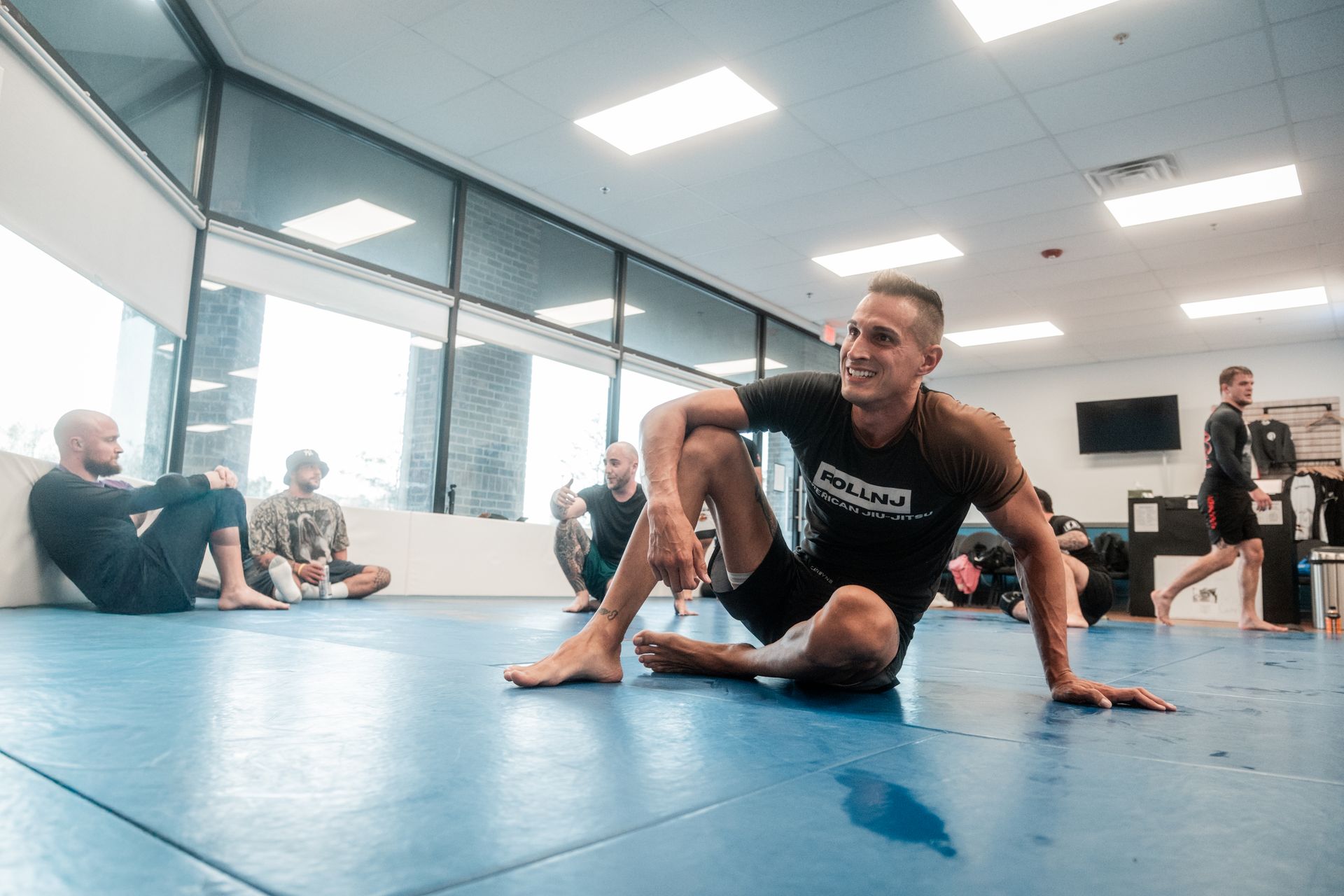
Our classes are structured, but not robotic. You will learn a skill, drill it with a partner, and then pressure-test it at an appropriate level. Some days feel technical and precise. Other days feel like a workout that sneaks up on you, the good kind where you notice you are breathing hard and then realize you are smiling anyway.
If you are looking specifically for Jiu-jitsu in Montgomery, NJ, this is the kind of training that tends to stick, because you can feel progress in small, real ways: better balance, better composure, better ability to stay safe in close contact.
What you actually learn in beginner-friendly Jiu-jitsu
A lot of adults hesitate because they imagine a room full of experts moving at lightning speed. We do not throw you into the deep end. We teach fundamentals in a way that is clear, step-by-step, and connected to real situations.
Here are a few core skills we build early, because they carry into everything else:
• Base and posture so you stay hard to knock over and harder to control
• Escapes from common pins so you can get back to safer positions
• Clinch awareness so grabs and body contact feel less overwhelming
• Positional control so you can slow a situation down and make better choices
• Basic submissions taught with safety and responsibility, not ego
• Takedown fundamentals and safe falling, because the ground is not forgiving
You do not need a background in wrestling or martial arts to learn these. You just need consistency, and a willingness to be a beginner for a little while.
Adult Jiu-jitsu in Montgomery, NJ: why grown-ups keep coming back
Adults often start for self-defense, then realize something else changes too. Training has a way of sharpening your attention. You have to notice small details, breathe through pressure, and solve problems with another person actively resisting. That kind of practice carries over.
There is also strong evidence that martial arts training supports cognitive benefits when practiced consistently. Many practitioners report improved confidence within the first year, and that makes sense: you are proving to yourself, week after week, that you can handle difficult moments.
If your goal is adult Jiu-jitsu in Montgomery, NJ, it helps to know what the journey typically feels like. Early on, you might feel awkward. Then you start recognizing positions. Then you begin making choices instead of reacting. The progress is not always linear, but it is real.
Fitness that does not feel like a treadmill
Jiu-jitsu training builds strength, grip endurance, mobility, and cardio, but it does not usually feel like counting reps. You are working with a partner, solving movement puzzles, and that keeps many adults engaged longer than typical gym routines.
You will still get tired, of course. Some rounds can be humbling. But the fatigue has a purpose, and purpose makes it easier to return.
Stress relief through structure and effort
A good class pulls you into the present. Your phone stays off. Your attention narrows to breathing, movement, and timing. People often leave feeling lighter, even when the training was hard.
We also keep the room respectful and focused. That environment matters. It is easier to learn when you feel safe, and it is easier to push yourself when you know the culture supports steady growth instead of proving something.
Self-defense is more than technique: awareness, boundaries, and choices
We love technique. But self-defense is bigger than a collection of moves. It starts earlier, with awareness and decision-making.
We talk about practical habits: maintaining distance when something feels off, using your voice clearly, positioning yourself near exits, and noticing when someone is testing boundaries. Jiu-jitsu supports that by giving you confidence in close range, which often reduces panic and improves judgment.
And we stay realistic about outcomes. The goal is not to “win” a street fight. The goal is to increase your ability to protect yourself, create space, and get home safely.
What makes modern Jiu-jitsu training especially effective right now
Jiu-jitsu has grown into a major driver of the martial arts industry, and the technical level keeps rising. That is good news for students, because modern classes tend to be more structured, safer, and more intentional than the old stereotype of “just roll and survive.”
We also pay attention to how grappling overlaps with real-world needs. Takedowns and wrestling-style control have become more emphasized in modern competition, and we integrate that idea carefully so you are not only training on the knees. Real life involves standing, balance, and unpredictable movement.
At the same time, we keep safety as a priority. Training should challenge you, not break you. You should leave with skills and energy, not chronic injuries.
How to start without overthinking it
Most people do not need a dramatic plan. You need a simple first step, then a second. If you are curious but unsure, this approach tends to work well:
1. Check the class schedule and pick a day you can actually repeat each week
2. Arrive a little early so you can settle in and ask quick questions
3. Focus on learning positions and escapes before worrying about “winning”
4. Train consistently for a month and track small improvements, not perfection
5. Adjust your pace so Jiu-jitsu supports your life instead of competing with it
If you do that, you are already ahead of the common pattern where people start too hard, get sore, then disappear. Consistency beats intensity, especially for adults.
The Montgomery, NJ factor: community, consistency, and real progress
Training in Montgomery is not just about the techniques. It is about being part of a steady, local rhythm. You see familiar faces, you learn partners’ styles, and you build trust over time. That trust makes training more productive, because you can practice with intensity while still keeping each other safe.
We also find that people here appreciate training that is practical and efficient. You want to know why something works, when to use it, and what to do if it fails. That is exactly how we teach: clear details, realistic troubleshooting, and repetition until it sticks.
When people search for Jiu-jitsu in Montgomery, NJ, what they are often really asking is, “Can I do this as an adult, with my schedule, and actually feel safer?” Our answer is yes, as long as you train progressively and keep showing up.
Take the Next Step
If you are ready to learn self-defense that holds up under pressure, Montgomery Brazilian Jiu-Jitsu is where we put that goal into a weekly practice you can sustain. We teach Jiu-jitsu as a skill set, a mindset, and a community habit, because that combination is what creates real change.
Whether you are starting from zero or returning after time away, we will meet you where you are, keep the training structured, and help you build confidence you can feel outside the gym at Montgomery Brazilian Jiu-Jitsu.
Improve your fitness, confidence, and grappling ability by joining a Jiu-Jitsu class at Montgomery Brazilian Jiu-Jitsu.