
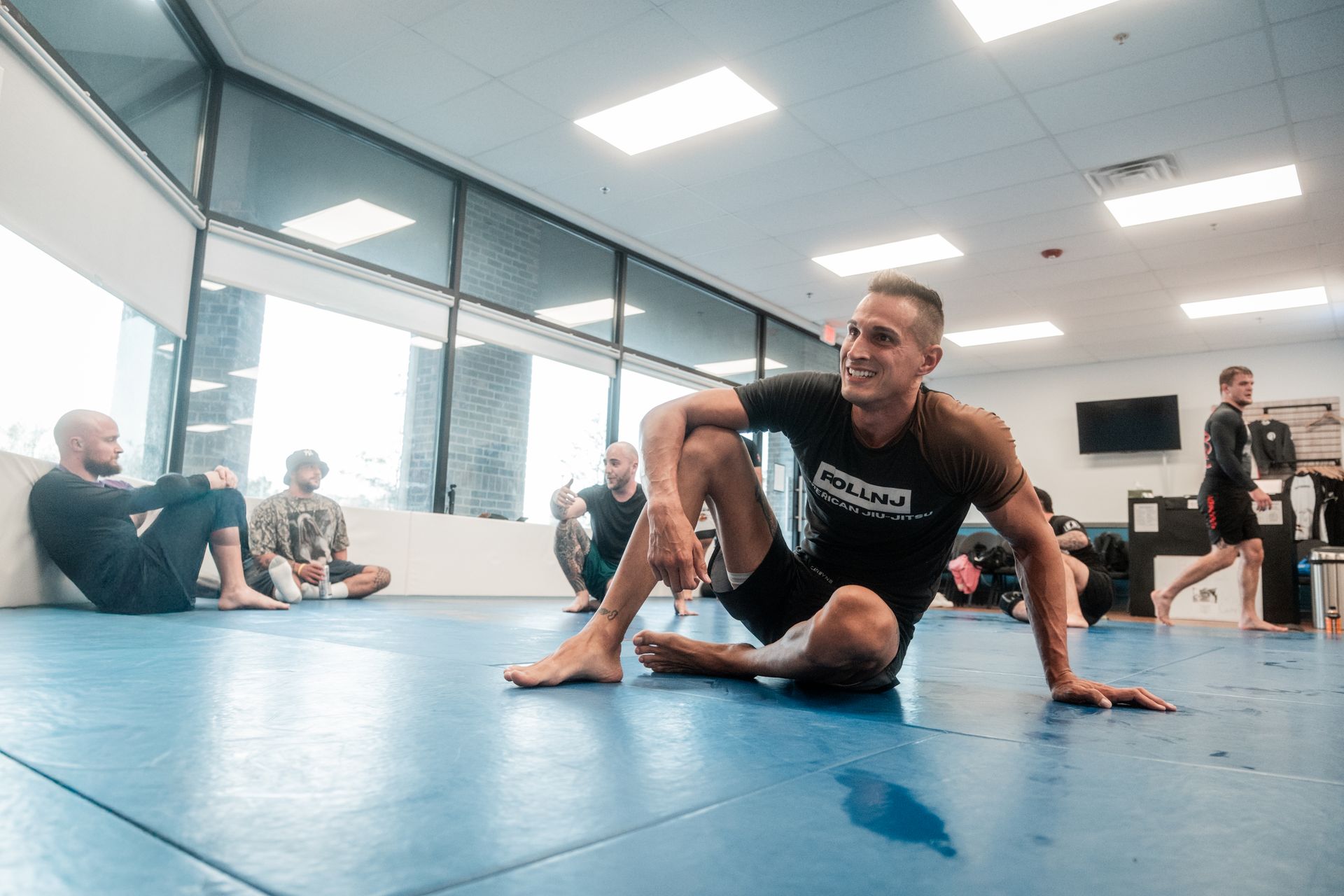
Jiu-jitsu gives your brain a break and your body a reset, all in the same hour.
If you live in Montgomery, you already know how quickly stress can pile up: work deadlines, commuting, family logistics, and the constant feeling that you should be doing one more thing. When that pressure becomes your default setting, “relax more” is not exactly a helpful plan. We prefer a practical approach: use training to change what your body and mind do under stress.
That’s where Jiu-jitsu fits surprisingly well. Yes, you’ll sweat and learn real skills, but what most adults notice first is the internal shift: you leave class clearer, calmer, and with more energy than you walked in with. It sounds backwards until you experience it consistently.
In our adult program, we see busy people in every stage of life learn how to downshift their nervous system, rebuild confidence, and get a full-body workout without feeling like you have to be “a gym person” first. If you’re looking for adult Jiu-jitsu in Montgomery, NJ that respects your schedule and your joints, the process can be a lot more approachable than you might think.
Why Stress Feels Different After Jiu-jitsu
Stress is not only mental. It’s chemical, physical, and habitual. When your day is packed, your body often runs on a steady mix of cortisol and adrenaline, even when you’re just sitting at a laptop. Jiu-jitsu gives those stress hormones somewhere to go. Physical exertion helps burn them off, and the endorphins that follow tend to create that grounded, post-training calm many adults crave.
There’s also a focus component you can’t fake. During drills or sparring, you can’t half-think about emails while someone is passing your guard. Your attention narrows to grips, balance, breathing, and timing. That intense, present-moment engagement is one reason people describe training as a kind of moving meditation.
A big part of our coaching is helping you keep the intensity productive instead of overwhelming. You’ll learn how to regulate effort, when to slow down, and how to make training challenging without turning it into a stress contest.
The “flow state” effect: a mental reset that actually sticks
Many adults struggle with rumination: replaying conversations, worrying about tomorrow, or carrying work home mentally. In Jiu-jitsu, the learning environment nudges your brain toward a “flow state,” where you’re fully engaged in one task at a time. That state supports mindfulness without asking you to sit perfectly still and empty your mind. You’re simply too busy solving real problems with your body.
Over time, that’s a skill you can bring into daily life. When you feel stress spike, you recognize it sooner, breathe better, and respond instead of reacting. That’s not motivational talk. It’s practice, repeated weekly.
The Neuroscience Behind Feeling Calmer and More Stable
We like explaining the “why,” because it helps you trust the process on days you show up tired. Jiu-jitsu asks your brain to plan, adapt, and regulate emotion in real time. Neurologically, training engages areas associated with decision-making and self-control, including the prefrontal cortex, which plays a role in emotional regulation.
You also get mood support through neurotransmitters commonly associated with well-being. Dopamine and serotonin shifts are often discussed in relation to exercise and skill learning, and Jiu-jitsu gives you both: physical work plus measurable progress. You’re not just burning calories. You’re learning timing, leverage, and strategy, which can be deeply satisfying for adults who live in their heads all day.
Another piece most people feel but don’t have words for is the nervous system shift. Hard rounds elevate your heart rate, but good coaching brings you back down. That recovery matters. When we coach controlled breathing and pacing, you practice moving from “fight-or-flight” into a calmer parasympathetic state. It’s basically rehearsal for stressful moments off the mats.
Stress Relief Without Beating Up Your Body
A common worry is whether Jiu-jitsu is “too intense,” especially if you’re new to martial arts or getting back into fitness after a long break. The truth is that intensity is adjustable. We can scale training so you build capacity gradually and safely, and we can match you with partners who help you learn, not just survive.
Brazilian Jiu-jitsu is also known for being lower impact than many striking sports because it emphasizes control, positions, and leverage. You’ll still move, twist, and work hard, but you’re not required to absorb repetitive punches or high-impact collisions. For many adults, that makes Jiu-jitsu in Montgomery, NJ a more sustainable long-term training choice.
What makes training feel safe and doable for adults
We keep adult classes structured so you’re not thrown into chaos. You’ll learn fundamentals first, repeat them often, and add resistance only when you’re ready. In practical terms, that means:
• You start with positional basics so you understand where to put your hands, hips, and feet under pressure
• You learn to tap early and often, which is a skill, not a weakness
• You build conditioning naturally through rounds that match your current pace
• You get coaching on control so training stays technical, not reckless
• You progress step by step, which reduces injury risk and mental overwhelm
This is also why adults over 40 often do well. When technique is prioritized, you don’t need to rely on speed or strength to have productive training.
How Jiu-jitsu Boosts Energy for Busy Montgomery Adults
It’s normal to assume exercise will drain you. But energy is not only about rest. It’s also about circulation, breathing efficiency, and confidence in your body. Jiu-jitsu improves cardiovascular conditioning, strength, flexibility, and coordination in a way that stays interesting. You’re solving puzzles with movement, which tends to wake people up, mentally and physically.
We also see a practical lifestyle effect: training creates a boundary in the day. When you show up to class, you step out of work mode, parent mode, and phone mode. That mental separation often leads to better sleep quality and a more stable mood, which feeds energy the next day.
If you’re juggling a lot, the goal is not to train like a professional athlete. The goal is to train consistently enough that your baseline improves. Two or three sessions a week is a sweet spot for most adults who want noticeable stress relief and better daily energy without burnout.
What a Typical Adult Class Looks Like (So You Can Picture It)
Walking into something new can be the biggest hurdle. Our adult classes follow a rhythm that helps you settle in quickly. You’ll usually see a blend of beginners and more experienced students, and we teach in a way that gives everyone something useful to work on.
A typical class includes a warm-up that prepares joints and movement patterns, technique instruction with drilling, and optional live training (often called rolling). Rolling is where you apply the skills with a partner in a controlled setting. It can look intense from the outside, but it’s really structured problem-solving with feedback, especially when you’re starting out.
You don’t need to “get in shape first.” Training is how you get in shape. And you don’t need to be fearless, either. Most adults are a little nervous on day one. That’s normal. We build comfort through clear coaching and steady progression.
Rolling as Stress Training: Rewiring Your Response Under Pressure
Here’s a simple truth: stress management is hard to practice when nothing is at stake. Jiu-jitsu gives you a safe way to feel pressure and work through it. During a round, you might feel your breath shorten, your shoulders tense, and your mind race. Then you learn what to do next: frame, breathe, recover position, and make a calm decision.
That’s not just a sport skill. That’s life. The better you get at staying composed while someone is trying to control you, the more you trust yourself when life feels heavy. This is one reason adult Jiu-jitsu in Montgomery, NJ has become so appealing to professionals. It’s a real-time feedback loop for posture, breathing, and decision-making.
There’s also strong data supporting the mental benefits people report. In one study of adult participants, 87.5 percent reported reduced anxiety, 96.9 percent reported better mood, 87.6 percent reported improved confidence, and 81.3 percent reported enhanced mental flexibility from BJJ training. Those numbers line up with what we hear all the time: you don’t just learn techniques, you become harder to rattle.
A Simple Weekly Plan That Builds Calm and Energy
Consistency beats intensity, especially for adults managing work and family responsibilities. If you want results you can feel, we recommend building a rhythm you can keep even during busy weeks. Here’s a straightforward approach we see work well:
1. Start with 2 classes per week for the first month to build comfort and recovery
2. Add a third session if your energy and schedule support it, not because you “should”
3. Treat your first 10 minutes as a breathing and focus practice, not just a warm-up
4. Keep rolling light at first and prioritize learning positions over “winning”
5. Track sleep, mood, and daytime energy for a few weeks to notice the changes
If you’re already active, you may adapt quickly. If you’re coming in stressed and depleted, give yourself permission to ramp up gradually. Either way, Jiu-jitsu rewards patience.
Community: The Overlooked Energy Multiplier
Stress thrives in isolation. One of the most helpful parts of training is having a place you can show up regularly, be known by name, and work toward goals alongside other adults. The social side is not forced or performative. It’s more like: you sweat together, learn together, and slowly realize you’re not carrying everything alone.
In surveys, many practitioners report a strong sense of belonging, and that checks out with what we see on the mats. Community makes it easier to stay consistent, and consistency is where the stress relief and energy gains really compound.
For Montgomery locals, that matters. Suburban life can be comfortable and still feel strangely draining. When your week is mostly car rides, screens, and responsibilities, it helps to have a physical practice that brings you back to yourself, and people around you who get it.
Take the Next Step
Building a calmer nervous system and steadier energy is not about one perfect workout. It’s about a practice you can return to, week after week, even when life is busy. Jiu-jitsu works because it trains your body, your focus, and your stress response at the same time, and you can start at any fitness level.
At Montgomery Brazilian Jiu-Jitsu, we structure adult training so you can learn fundamentals safely, build real conditioning, and leave class feeling more capable than when you arrived. If you’re ready to experience what that kind of training does for your mood, confidence, and daily energy, our doors are open.
Train with experienced instructors and a supportive team by joining a Jiu-Jitsu class at Montgomery Brazilian Jiu-Jitsu.