
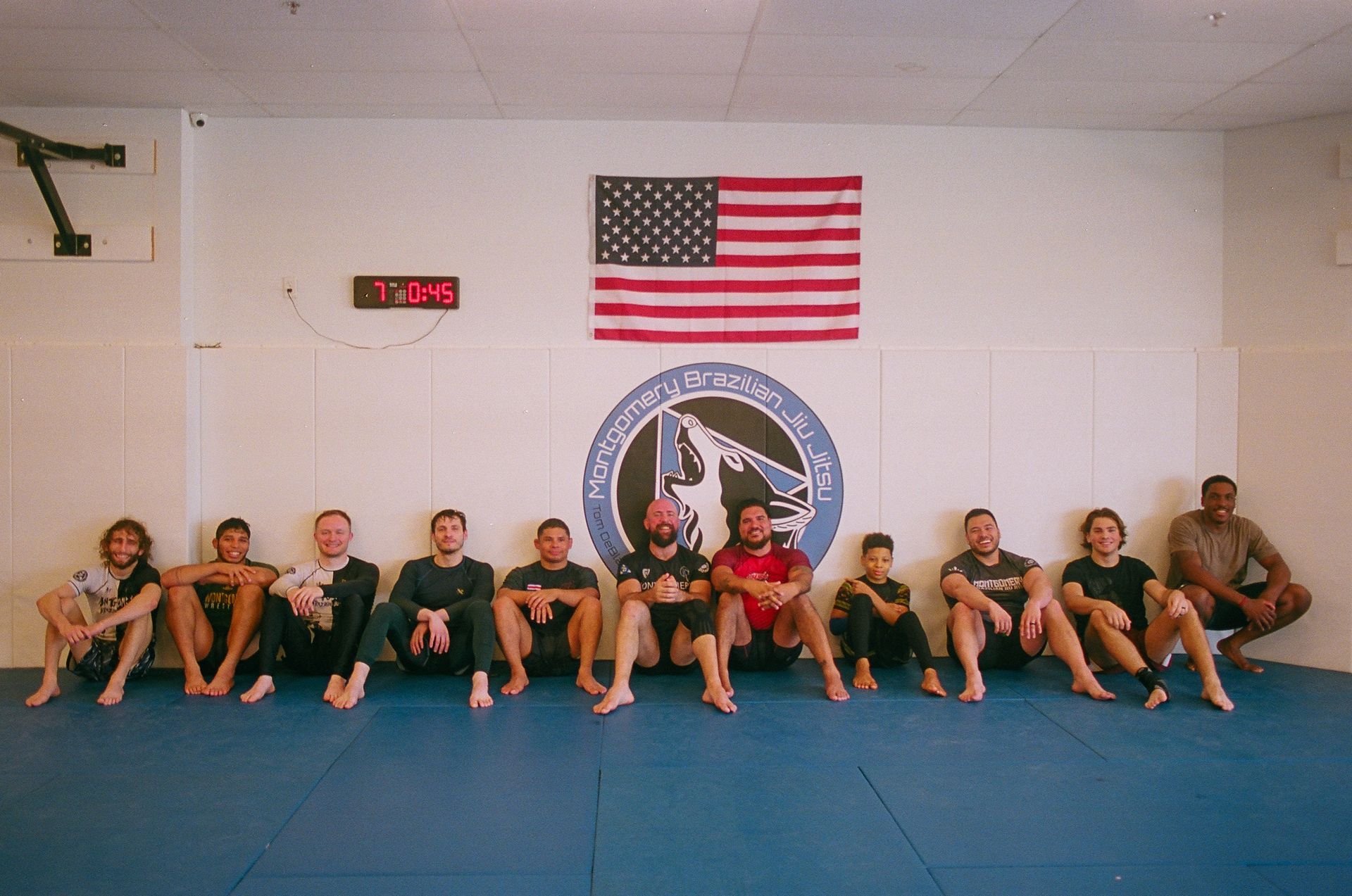
The fastest way to feel confident on the mats is to learn a handful of fundamentals that show up in almost every round.
Brazilian Jiu-jitsu has exploded in popularity for a reason: it gives regular adults a practical, problem solving way to get fitter, calmer under pressure, and more capable without needing to be the strongest person in the room. Worldwide participation is estimated in the millions, and the US alone has hundreds of thousands of practitioners, with steady growth continuing year after year. We see that trend locally too, especially with adults who want training that feels challenging but not reckless.
If you are brand new, it helps to know what to focus on first. The early months can feel like learning a new language, and your brain is doing as much work as your body. Our job is to give you a clear path so you are not guessing. In this guide, we will walk through the Jiu-jitsu techniques every adult beginner in Montgomery should know, why each one matters, and how we teach you to apply them safely.
One more reassuring note: you do not need to be young, explosive, or flexible to start. Many beginners are in their 30s, 40s, and beyond, and we plan training in a way that respects real life bodies, desk job hips, tight shoulders, and busy schedules.
Why adult beginners should prioritize positions before submissions
New students often ask what the best submission is. The real answer is that the best submission is the one you can reach after you control position. In beginner training, we emphasize survival, escapes, and stable top control first because those skills reduce panic and reduce injuries.
In competition trends, chokes consistently finish more matches than joint locks, and control based grappling keeps showing up even as styles evolve. That is not just for competitors. For adult Jiu-jitsu in Montgomery, NJ, it means your fastest progress usually comes from learning how to hold, how to move, and how to get safe again when you are stuck.
A simple way to think about it is this: positions are where you live, submissions are where you visit. If you can live comfortably in side control, mount, and back control, you will naturally find clean finishes later.
Movement fundamentals: the two escapes that save beginners
The shrimp or hip escape
If we could give every beginner one superpower, it would be the shrimp. You use it to make space, recover guard, and stop someone from climbing higher on you. It shows up from bottom side control, bottom mount, and even when you are trying to re guard after a scramble.
What we cue in class is simple: get on your side, frame with your arms, and push your hips away like you are sliding your belt line out from under pressure. The shrimp is not about speed. It is about timing and angles. When you shrimp at the right moment, you can feel the pressure lighten and the space appear.
A common beginner mistake is trying to bench press the person on top. We would rather you build a frame, turn, and move your hips. Your arms will thank you later.
The bridge and roll or upa
The bridge is your other emergency tool, especially from bottom mount. When someone is sitting heavy on your hips, you bridge to off balance them, then trap an arm and foot to roll. Even if you do not get the full reversal, the bridge creates reactions that help you recover half guard or create space to shrimp.
We teach bridging with control, not wild bucking. Think of it as lifting your hips toward the ceiling, then steering the person’s weight over a corner. Once you learn how to combine bridge and shrimp, you can escape far more situations than you would expect as a beginner.
The technical stand up: getting up without giving up your back
Most real world scenarios, and plenty of training rounds too, come down to one question: can you stand up safely? The technical stand up is how you get to your feet while protecting your head and keeping distance.
We teach you to post on one hand behind you, keep the opposite hand in front to frame, and stand up by sliding your leg under you rather than leaning forward. The detail that matters is your posture. If you fold at the waist, you get pulled back down. If you keep your spine tall and your eyes up, you stand up with balance.
This is one of those techniques that feels awkward at first, then becomes automatic. Once it clicks, you start using it everywhere, even in warmups.
Guard basics: closed guard, frames, and keeping your hips alive
Guard is a core reason Jiu-jitsu works for smaller and older beginners. It gives you structure from the bottom so you can manage distance and slow down a stronger partner. Closed guard is often the first guard adults learn because it is straightforward: legs locked, posture broken, hands controlling.
We focus on three beginner goals in guard. First, keep your hips active so you can pivot and create angles. Second, win inside control with your legs and grips so your partner cannot easily stand and pass. Third, learn how to attack without sacrificing your safety.
Guard retention is not one technique, it is a habit. You recover your knees between you and your partner, you re frame when your frames collapse, and you move your hips before you move your hands. If you can do that, you will feel far less stuck during live rounds.
Passing fundamentals: how beginners should think about getting around the legs
From the top, your first job is not to smash forward. Your first job is to clear the feet, then the knees, then settle your weight. Passing is frustrating early on because a good guard makes you feel like you are walking through tall grass.
We teach adult beginners to pass with posture and patience. Keep your head up, do not reach with your arms, and do not let your elbows drift away from your ribs. As you move side to side, you are looking for a moment when the guard opens or the knees separate.
A beginner friendly concept is the knee slice pathway. You create an angle, bring your knee through, and use your upper body to control the far shoulder. Even when you do not finish the pass, the pattern teaches you how to combine lower body positioning with upper body control, which is the heart of good passing.
Pinning positions: side control and mount done the right way
Side control essentials
Side control is one of the most common positions in Jiu-jitsu in Montgomery, NJ classes because it teaches pressure and control without relying on strength. We train you to control the near hip and the far shoulder, keep your weight heavy through your chest, and adjust your knees so you do not get re guarded.
The biggest shift for adult beginners is learning to relax. When you stop squeezing and start balancing, your side control gets tighter. Your partner feels pinned, and you feel like you can breathe.
From side control, we also teach you to anticipate the two most common escapes: the underhook to knees and the frame and shrimp. When you recognize those early, you can switch to a safer angle or transition to mount.
Mount basics that do not burn out your legs
Mount is powerful, but beginners often hold it like a plank and gas out. We coach mount as a series of adjustments. Your knees pinch just enough, your hips stay heavy, and your hands post when you need balance. The goal is to make your partner carry your weight while you stay calm.
Mount also introduces a key concept: high mount. When you climb higher, your opponent’s hips become less useful for bridging and shrimping. That is why mount is such a strong platform for submissions like the americana, and why escapes are a big part of our beginner curriculum.
Back control: the most important finishing position for beginners
If you ask us to pick one position that changes everything for a beginner, it is back control. When you have the back with hooks and a seatbelt grip, you can control someone larger than you with leverage instead of muscle.
Back control also leads to the highest percentage beginner submission: the rear naked choke. In recent major grappling events, chokes dominate finishes, and we see the same pattern in training because chokes reward good positioning. You do not need to crank anything. You just need alignment and patience.
We teach you to keep your chest connected, keep your head safe, and fight for the top hand. The submission comes after control, not before.
Three beginner submissions we teach with safety in mind
Submissions matter, and adults usually want to learn them. We just teach them in a way that protects your training partners and your joints.
Here are three staples we build around:
• Rear naked choke: This is the cleanest finish from back control, and it teaches you hand fighting, patience, and how to apply pressure without panic.
• Americana from mount: This shoulder lock introduces you to isolating an arm, controlling the elbow line, and finishing slowly with a steady range of motion.
• Cross collar choke in the gi: This classic choke teaches grip placement, posture breaking, and how to use your whole body, not just your arms.
We also talk about tapping early and finishing slow. As adults, we are here to train next week too. Safe habits are a skill, and we treat that skill seriously.
A simple training plan for adult beginners in Montgomery
Adults make progress when training is consistent, not extreme. We typically recommend starting with two to three classes per week. That schedule is frequent enough to build momentum, but spaced enough to recover, especially if you sit at a desk all day or you are juggling family routines.
In class, we balance drilling and controlled sparring. Drilling is where you build clean reps and confidence. Sparring is where you learn timing and decision making. When you blend both, Jiu-jitsu starts to feel less like random chaos and more like a puzzle you can actually solve.
If you want a practical way to measure progress, track how often you can do three things: escape a bad position, recover guard, and hold top control for ten seconds. Those are beginner milestones that show real improvement, even before you are submitting anyone.
What to expect in your first few weeks on the mats
Your first class should feel structured. We will show you how to move safely, how to fall, and how to work with a partner. Expect to feel a little clumsy. That is normal, and it fades faster than you think.
You will also notice the culture is detail oriented. Small changes like where your elbow sits, how your knee turns, or when you exhale can change the entire outcome. That is part of what makes Jiu-jitsu addictive in a good way. You can train hard without getting hit, and you can keep learning for years.
Gear wise, most adult beginners start with a gi, and some also train no gi with a rashguard. If you are not sure what you need, we help you sort it out so you do not overbuy.
Take the Next Step
If you are ready to learn skills that actually connect, we built our beginner approach at Montgomery Brazilian Jiu-Jitsu around these exact fundamentals: movement, control, escapes, and a few reliable finishes that work when you are tired. When you train with us, you will spend less time guessing and more time building a foundation you can feel in every round.
Adult Jiu-jitsu in Montgomery, NJ should fit your life, not take it over. Our classes are designed to help you train consistently, stay healthy, and keep progressing, whether your goal is fitness, stress relief, competition, or just learning something new in Montgomery.
No experience is needed to begin. Join a Jiu-Jitsu class at Montgomery Brazilian Jiu-Jitsu today.