
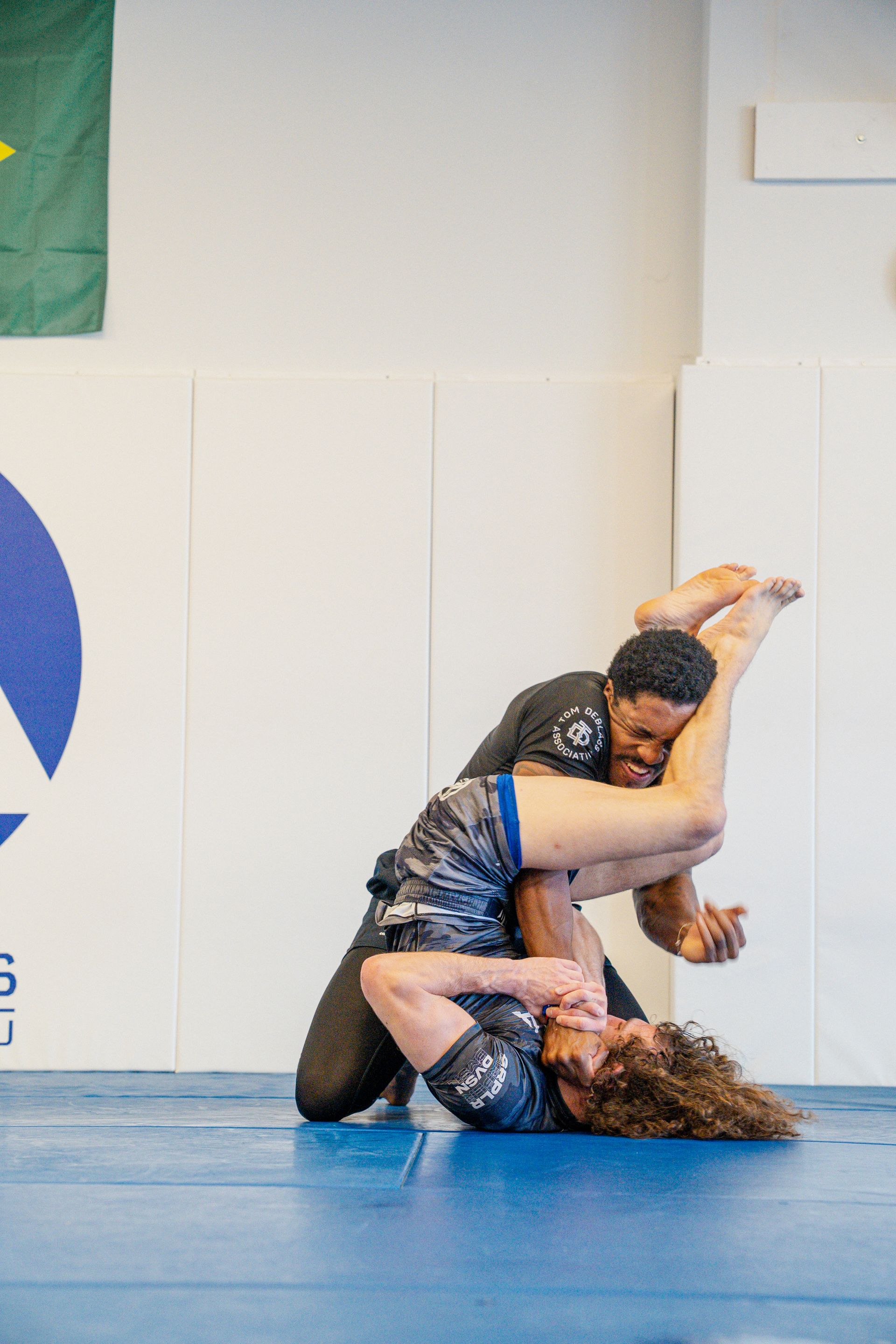
Better mobility means smoother guard work, safer escapes, and more comfortable training week after week.
If you train Jiu-jitsu long enough, you notice something pretty quickly: strength matters, technique matters more, but mobility is the quiet helper that keeps everything working. When your hips rotate easily, your spine moves segment by segment, and your shoulders and wrists can handle posting and framing, your mat movement feels cleaner. You waste less energy fighting your own tightness.
Around Montgomery, NJ, many adults we meet are balancing commuting, desk work, family schedules, and training. That often shows up as stiff hips, a tight upper back, and cranky wrists. The good news is you do not need to be naturally flexible to start Jiu-jitsu. You just need a simple mobility plan you can repeat, and a few moves that directly match what you do on the mat.
In this guide, we are focusing on the joints that take the most repeated loading in grappling: hips, spine, shoulders, wrists, and ankles. We will show you our favorite mobility moves, plus an easy way to use them before class and on recovery days so your training in Jiu-Jitsu in Montgomery, NJ feels more sustainable.
Why mobility matters for Jiu-jitsu (and what it is not)
Mobility is your ability to actively control range of motion, not just drop into a stretch and hope for the best. In Jiu-jitsu, you constantly move through awkward angles: hip escaping, inverting, stepping around legs, framing under pressure, and rotating to finish or defend submissions. That is why dynamic mobility tends to carry over better than passive stretching alone.
Good mobility work also teaches you body awareness. When you can feel where your ribs stop moving, or which hip does not internally rotate, you start solving problems earlier. That can mean cleaner guard retention, easier passing pressure, and fewer “why does my back feel weird after class” moments.
The five joints we prioritize for BJJ-specific mobility
Hips
Your hips drive guard retention, hip escapes, triangles, and almost every technical stand-up you will ever do. We prioritize internal rotation, external rotation, and adductor length because those show up in open guard, shin-to-shin, and wide base passing.
Spine (especially thoracic)
A stiff upper back forces your shoulders and neck to do too much. Thoracic rotation helps you pummel for underhooks, turn the corner when passing, and breathe better under pressure.
Shoulders
Frames, collar ties, and posting all demand shoulder stability with usable overhead and forward flexion. We like drills that blend range with control, not loose flopping.
Wrists
Gripping, posting, and playing guard on your hands can make wrists feel beat up. A few minutes of wrist prep can make a big difference, especially for beginners.
Ankles
Ankle dorsiflexion affects squats, standing passes, and base. Tight ankles often show up as heels popping up, knees collapsing inward, or feeling unstable when you try to drive forward.
The top mobility moves we recommend for students in Montgomery
Below are our go-to movements for a practical, repeatable routine. None of these need fancy equipment. A mat helps, but your living room carpet works.
1) 90 90 hip switches
Sit with one leg in front and one leg behind, both bent about 90 degrees. Rotate your knees side to side without using your hands as much as you can. Move slowly, and try to keep your chest tall.
Why it helps: This trains active hip internal and external rotation, which directly supports open guard transitions and hip escapes.
Modification: If your knees float up a lot, place your hands behind you lightly and reduce the range while you build control.
2) Shinbox to hip lift (shinbox opener)
From the 90 90 position, lean slightly toward the front shin and squeeze your glutes to lift your hips a few inches, then lower with control. Switch sides after a few reps.
Why it helps: It opens the front of the hip and teaches you to use glutes instead of dumping into the lower back, which is useful for bridging and guard angles.
3) Cossack squats (side-to-side squats)
Stand wide, shift into one side, and sit down toward that heel while the other leg stays straight. Keep your chest up and your foot on the bent-knee side grounded.
Why it helps: Cossacks build adductor length and strength together, which supports wide base passing and helps your guard feel less “stuck.”
Modification: Hold onto a wall or a sturdy surface so you can stay upright while your hips adapt.
4) Low lunge rocks (lizard-style rocks)
Step into a long lunge with your back knee down. Keep the front foot flat and rock forward and back slowly, aiming your knee forward over the toes without the heel lifting.
Why it helps: This improves hip extension and ankle dorsiflexion, which supports pressure passing posture and more comfortable kneeling positions.
Tip: Move like you are greasing a hinge, not bouncing.
5) Adductor rocks (from hands and knees)
Start on all fours. Extend one leg out to the side with the foot flat or heel down, then rock your hips back toward your heel and forward again.
Why it helps: This targets inner thigh mobility for guard work, especially when your knees flare out to retain or recover guard.
Modification: Keep the range small at first. You should feel a stretch, not a sharp pull near the groin.
6) Cat-cow with a slow exhale
On hands and knees, round your back gently (cat) and then extend into a comfortable arch (cow). Add a slow exhale as you round to help your ribs move.
Why it helps: It restores spinal motion after sitting and prepares you to flex and extend under pressure without feeling jammed.
Common mistake: Cranking your neck. Let the movement travel through your spine instead.
7) Thread-the-needle thoracic rotations
From all fours, slide one arm under your body and rotate until your shoulder approaches the mat. Pause, breathe, then rotate the opposite way by opening your chest.
Why it helps: Thoracic rotation improves your ability to frame, pummel, and turn your shoulders when you are fighting for inside position.
Modification: Keep your supporting elbow slightly bent if your shoulder feels pinchy.
8) Shoulder flexion drill (puppy-style reach)
From hands and knees, walk your hands forward and sink your chest slightly while keeping your ribs controlled. Think of lengthening your lats without dumping into your lower back.
Why it helps: Better overhead and forward shoulder flexion supports framing, underhooks, and healthier posture during gripping battles.
Tip: If your lower back takes over, shorten the reach and exhale as you settle.
9) Wrist rocks and wrist circles
Place your palms down with fingers forward and gently rock forward and back. Then turn fingers to the side and repeat. Finish with slow circles, both directions.
Why it helps: It prepares your wrists for posting and weight-bearing, which shows up constantly in scrambles and base building.
Modification: Do it on fists or forearms if extension is too intense at first.
10) Squat pry with breathing
Hold a deep squat as comfortably as you can, heels down if possible. Use elbows inside knees to gently pry, shift side to side, and take slow breaths.
Why it helps: This ties together ankles, hips, and spine in a position you use for takedown entries, standing up in base, and passing posture changes.
Modification: Put a small towel under your heels so you can stay balanced while building ankle range.
A simple way to use these: 5 minutes before class, 10 minutes after
A mobility routine only works if you actually do it. We like short blocks that fit real schedules, especially for adults trying Adult Jiu-Jitsu in Montgomery, NJ before or after work.
5-minute pre-class mobility (keep it dynamic)
Use this when you want your body to feel warm and ready, not sleepy.
1. Cat-cow with slow exhale: 6 reps
2. 90 90 hip switches: 60 seconds
3. Low lunge rocks: 45 seconds each side
4. Wrist rocks and circles: 60 seconds
5. Thread-the-needle rotations: 3 each side
10-minute post-class recovery (downshift and restore)
Use this when you feel tight after rolling and want to wake up better tomorrow.
• Squat pry with breathing: 90 seconds
• Adductor rocks: 60 seconds each side
• Shinbox to hip lift: 8 reps each side
• Shoulder flexion reach: 90 seconds
• Easy thoracic rotations: 60 seconds total
If you only pick one time to do mobility, choose pre-class. It tends to improve movement quality right away, and it makes Jiu-jitsu feel less “rusty” in the first round.
Common mobility mistakes we help students avoid
Going too hard is the biggest issue. Mobility work should create sensation, not pain. When you push through sharp discomfort, your body usually tightens up more, and you get the opposite result.
A few other pitfalls to watch for:
• Treating mobility like a passive stretch session, instead of controlled movement you own
• Skipping wrists and ankles because they seem small, then wondering why posting and base feel unstable
• Moving fast to “get it done,” which avoids the exact end ranges you need for Jiu-jitsu
• Forcing positions that your hips are not ready for, rather than using a smaller range consistently
• Holding your breath, especially in deep squat or shoulder work, which makes you tense and limited
If you are new to Jiu-Jitsu in Montgomery, NJ and you feel stiff, that is normal. The win is showing up consistently and stacking small improvements.
How often should you do mobility outside of class?
For most adults, two to four short sessions per week is the sweet spot. That might mean 5 minutes on two weekdays and 10 minutes once on the weekend. The goal is not to become a contortionist. The goal is to move better in common positions, recover faster, and train Jiu-jitsu without feeling like your joints are always behind.
If you are dealing with a current injury or persistent pain, keep your ranges smaller and talk with a qualified medical provider. On our end, we keep class training progressive and can suggest safer variations so you can keep building momentum.
Ready to Train Smarter in Montgomery?
If you want your training to feel smoother, mobility is one of the simplest levers you can pull. A few minutes focused on hips, spine, shoulders, wrists, and ankles can make guard movement easier, passing more stable, and recovery less of a guessing game. That is exactly why we encourage students to treat mobility as part of learning Jiu-jitsu, not a separate project.
At Montgomery Brazilian Jiu-Jitsu, we build our classes so you can develop skill while training in a way that supports long-term consistency. If you are looking for Adult Jiu-Jitsu in Montgomery, NJ and want a plan that makes progress feel realistic, we would love to help you get started.
Build stronger grappling fundamentals and improve your technique by training at Montgomery Brazilian Jiu-Jitsu.