
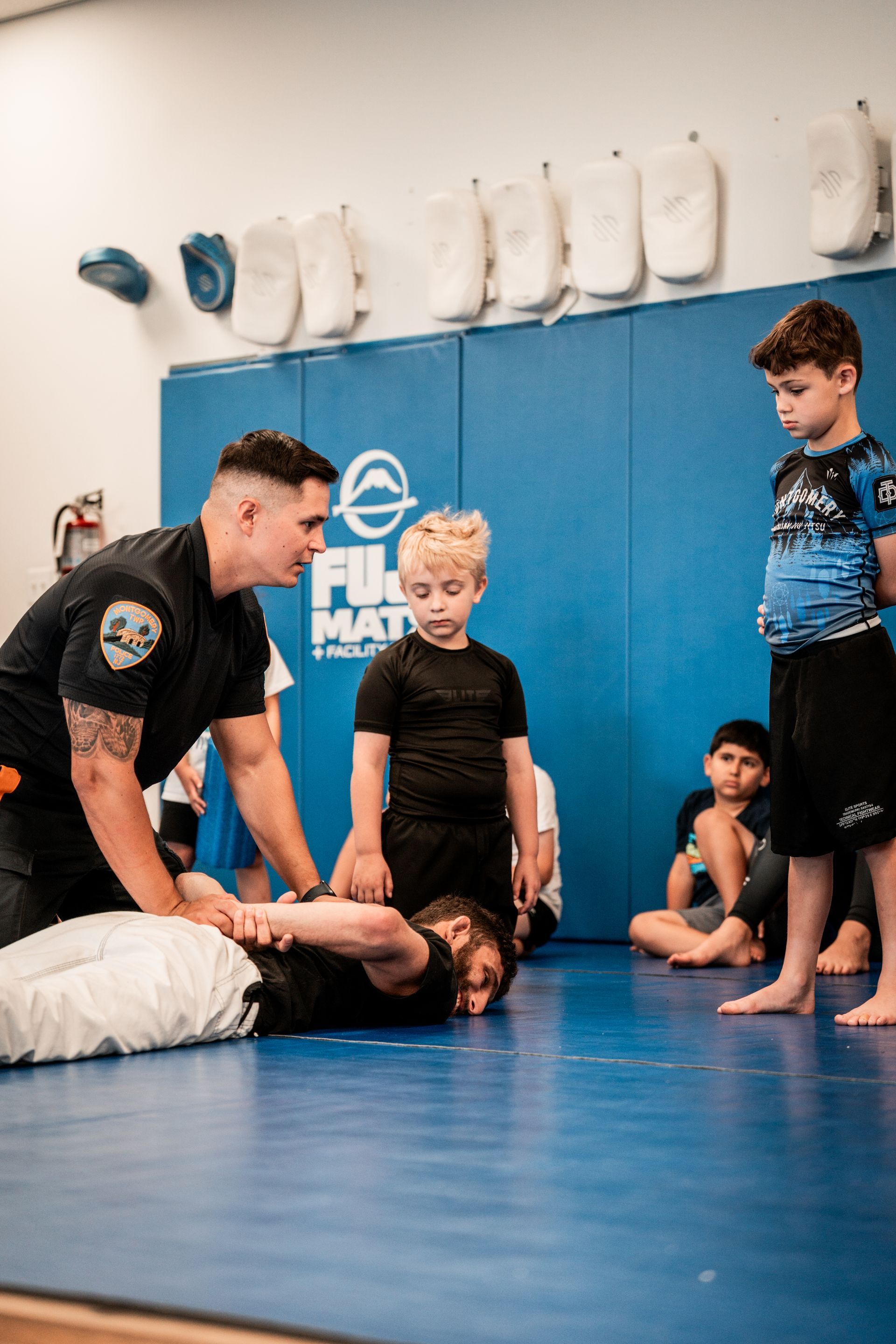
Youth Jiu-Jitsu gives kids a place to move, focus, and grow into calmer confidence, one class at a time.
Most parents in Montgomery are juggling the same mix: school expectations, busy after-school schedules, and the constant pull of screens. Youth Jiu-Jitsu fits into that reality because it solves more than one problem at once. It gives your child structured movement, real skill-building, and a supportive routine that feels productive (and, yes, fun).
In our Youth Jiu-Jitsu program, we see a simple pattern: when kids practice learning and staying composed under pressure, that habit starts showing up outside the mats too. Research on youth martial arts consistently links training with improvements in fitness qualities like strength, flexibility, balance, coordination, and overall conditioning, along with positive changes in confidence and self-control. Those are big claims, but the day-to-day proof is small moments: a kid who used to quit tries again, or a shy student starts speaking up during drills.
And because Montgomery, NJ already has a sports-oriented community that values youth development, this kind of structured training tends to click quickly. You are not adding “one more activity” just to fill time. You are choosing a program that can turn everyday challenges into real achievements.
Why Youth Jiu-Jitsu works so well for Montgomery families
Montgomery families often look for activities that build character without piling on stress. Youth Jiu-Jitsu can be that steady middle ground: athletic enough to feel like a sport, structured enough to reinforce discipline, and practical enough to help with confidence and bullying resilience.
We also keep the environment predictable. Kids thrive when they know what to expect: warm-ups, technique practice, partner drills, then controlled training games that help connect the dots. That structure matters for focus, especially after a long school day.
Finally, jiu-jitsu gives kids a rare kind of “win.” It is not only about being fast or strong. A smaller child can use leverage, timing, and positioning to solve problems. That shifts a lot of inner narratives in a healthy direction.
What your child gains beyond self-defense
People often start searching for Youth Jiu-Jitsu because of safety or bullying concerns, but what we build goes wider than that. Modern youth martial arts research points toward benefits in physical fitness and psychosocial skills, including emotional regulation, self-control, and reduced aggression. We see those outcomes when the training stays age-appropriate, consistent, and well-coached.
Physical development that supports every sport (and everyday life)
Youth bodies are built to move, but they need variety. Jiu-jitsu challenges the full system: pushing, pulling, rotating, balancing, and coordinating with another person.
Over time, many kids improve in:
- Strength and muscular endurance through bodyweight movement
- Flexibility and mobility from repeated, controlled positions
- Balance and coordination from learning how to base, post, and recover
- Cardiorespiratory fitness through active rounds and games
- Body awareness, which helps with safer movement in general
These are the kinds of improvements that can support school PE, weekend sports, and even just feeling more comfortable in their own body.
Emotional regulation and self-control under pressure
One of the most practical benefits of jiu-jitsu is learning to stay calm while solving a problem. A child is not just “doing moves.” Your child is practicing how to breathe, listen, and make decisions while their heart rate is up. That is a real skill.
We coach kids to pause, reset, and try again instead of reacting impulsively. Over time, that can translate into better frustration tolerance at home and improved patience with schoolwork.
Confidence that is earned, not hyped up
We do not rely on pep talks. Confidence in jiu-jitsu comes from evidence: “I learned something difficult and I can do it again.” Belts and stripes help track progress, but the real confidence comes from repetition and responsible challenge.
For kids who struggle with self-esteem, this matters because progress is visible and measurable. You can watch the “I can’t” turn into “I’ll try” and then into “I’ve got it.”
Youth Jiu-Jitsu and bullying: resilience, boundaries, and safer choices
Parents ask this directly, and it deserves a direct answer. Youth Jiu-Jitsu can help with bullying, but not because we teach kids to fight. We teach skills that support better outcomes: awareness, posture, boundary-setting, and practical escape concepts that prioritize safety.
Many bullying situations are not movie-style attacks. They are social pressure, name-calling, or unwanted grabbing in hallways and on buses. We focus on a few priorities:
- Build confident body language and calm eye contact
- Practice assertive, simple verbal responses
- Teach how to disengage and create space
- Reinforce that telling a trusted adult is part of a smart plan, not “tattling”
- Train controlled physical skills in a safe setting so fear does not run the show
This is where Youth Jiu-Jitsu in Montgomery, NJ becomes more than an activity. It can be part of a child’s overall safety and confidence toolkit.
Who our Youth Jiu-Jitsu program is for
Kids do not come to us as finished products. They show up as themselves, and that is the point. We coach the child you have right now.
Shy kids who need a low-pressure way to connect
Jiu-jitsu creates built-in social structure. Partners change, drills have clear rules, and conversation happens naturally without forcing it. Shy students often start by listening and observing, then gradually participate more as comfort grows.
Energetic kids who need structure (not more “sit still”)
Some kids have plenty of energy and get labeled as “too much.” On the mat, that energy becomes fuel, but we put it inside a system: line up, listen, move with purpose, control your partner, control yourself. That combination is powerful.
Kids who have trouble focusing
Focus is a trainable skill. Our classes reward attention in small ways: remembering steps, responding to cues, and adjusting during drills. Because the learning is physical and interactive, many kids find it easier to lock in than in purely classroom-style activities.
First-time athletes who feel behind
Jiu-jitsu does not require prior sports experience. We start with fundamentals and build. If your child has not clicked with team sports, Youth Jiu-Jitsu can feel like a fresh start where progress is personal, not based on getting picked first.
Is youth jiu-jitsu safe for beginners?
Safety is not an afterthought in our program. It is built into how we teach: progressive instruction, controlled partner work, and clear rules.
We keep beginner students safe by emphasizing:
- Tapping early and respecting taps immediately
- Age-appropriate techniques and partner pairings
- Clear boundaries around intensity and roughness
- Coaches actively watching and correcting positions
- A culture where control matters more than “winning”
Injuries can happen in any sport, but we reduce risk by focusing on technique, supervision, and pacing. We would rather your child learn one concept well than rush through ten.
What a first class looks like (and what to bring)
Starting anything new can feel like a lot, especially for kids who worry about doing it “wrong.” We make the first class simple and welcoming.
A typical first Youth Jiu-Jitsu class includes:
1. A quick orientation so your child knows the basic rules and expectations
2. A warm-up focused on safe movement patterns like shrimping, rolling, and bear crawls
3. Technique practice where we demonstrate, then help your child drill it step by step
4. Partner drills or games designed to apply the skill without chaos
5. A short wrap-up where we reinforce effort, listening, and progress
For what to wear, you can start with comfortable athletic clothes. If your child continues, we will guide you on uniform options and anything else needed for training.
Classes usually run around 45 to 60 minutes for kids, depending on age group and how the schedule is organized. That is long enough to learn and sweat, but not so long that attention falls apart.
How we track progress: belts, habits, and real skill
Kids like milestones, and parents like clarity. We use a structured approach to track progress that blends technical development with the habits that make training work.
In Youth Jiu-Jitsu, progress is not only “Can you do the move?” It is also:
- Can you listen, follow directions, and stay respectful?
- Can you practice with control and keep partners safe?
- Can you keep trying even when something feels hard?
- Can you apply a technique in a coached, appropriate way?
Belts and stripes help kids see the path forward. The deeper win is that your child learns how to improve through steady effort, which is the same formula for school, sports, and life.
How often should kids train each week?
Consistency beats intensity for kids. For most families, two classes per week is a strong starting point. It builds rhythm without overwhelming schedules, and it gives enough repetition for skills to stick.
If your child loves it and wants more mat time, we can help you choose an appropriate pace. Some kids do great with three days a week, especially if they benefit from routine and physical outlets. The key is recovery, school balance, and keeping training positive.
Youth Jiu-Jitsu compared to other activities: why this feels different
Parents sometimes ask how jiu-jitsu fits alongside typical youth athletics in Montgomery. The simplest answer is that jiu-jitsu offers individual progress inside a group environment. Your child does not have to wait for more playing time to get better. Every class is participation.
Jiu-jitsu also teaches problem-solving in real time. Kids learn patterns, but they also learn adaptation: if one option is blocked, try another. That kind of thinking can help with resilience in schoolwork and better decision-making under stress.
And because Jiu-Jitsu in Montgomery, NJ often becomes a routine rather than a short season, it can provide stable growth over months and years, not just a few weeks.
What parents should look for in a youth program
If you are reading this, you are already doing the most important thing: paying attention to fit and quality. A solid Youth Jiu-Jitsu program should feel safe, structured, and development-focused.
Here is what we believe matters most:
- Clear class organization with age-appropriate coaching
- Active supervision during partner drills, not “free-for-all” chaos
- A culture of respect where tapping and safety rules are non-negotiable
- Progress tracking that values behavior and effort alongside technique
- Communication that helps you understand goals, schedules, and expectations
When those pieces are in place, kids tend to thrive, and parents feel confident about the time investment.
Take the Next Step
If you want Youth Jiu-Jitsu in Montgomery, NJ that balances real skill-building with a supportive, safety-first environment, our team is ready to help you get started in a way that feels comfortable for your child. We keep the learning practical, structured, and encouraging so progress feels earned and steady.
When you train with us at Montgomery Brazilian Jiu-Jitsu, you are not just adding an activity to the calendar. You are giving your child a place to build fitness, focus, self-control, and confidence that carries into school, friendships, and home routines.
Put these techniques into practice by joining a Brazilian Jiu-Jitsu program at Montgomery Brazilian Jiu-Jitsu.